
Selected translations
Red Skies by Charlotte Gneuß
In her searing debut novel, Charlotte Gneuss tells us stories from a country that no longer exists and asks whether innocence in a totalitarian state is possible. Her literary thriller is set in the former East Germany, in the Dresden suburb of Gittersee – a gripping debut from a new talent on the German literary scene.
Katrin Köhler is 16, experimenting with red lipstick and in love with Paul, an art school dreamer with a motorbike. But it’s 1976 in the former GDR, Karin’s parents’ marriage is on the verge of collapse as is the family’s Škoda, and Karin juggles school and her romantic life with caring for her toddler sister. When Paul’s road trip adventure leads to his disappearance, two policemen turn up at the family’s door and Karin, under suspicion and under pressure, becomes embroiled in a confusing web of misleading information. Unsure who she can trust, she has to navigate tense situations in which her double life threatens to unravel.
Arboretum Books · Fiction · 2026

Blood Money by Anna Seghers
It’s the summer of 1932, and Johann Schulz is accused of killing a police officer during a demonstration. Wanted for murder, Schulz leaves the city to seek shelter with his relatives in a small village on the Rhine. But the Nazis are beginning to recruit there, and it’s only a matter of time before the price on his head is too great a temptation for the villagers.
Blood Money, a novel of suspense and political upheaval, tracks the nascent rise of the Hitler movement in a German village: the old farmers disinterested, then capitulating; the young entranced by the promise of action and the rare chance at advancement. Anna Seghers began writing Blood Money in 1932 and completed it in exile a year later, after she was blacklisted in Germany and forced to leave. In this prescient novel, Seghers’s dispassionate realism opens our eyes to the massive dimensions of the impending political and moral collapse.
New York Review of Books · Fiction · 2026

Woman in the Pillory by Brigitte Reimann.
Kathrin – five years into a disenchanting marriage – struggles to work the farm with her sister-in-law while her husband Heinrich is away fighting for the Third Reich. To help them with the harvest, Heinrich arranges for Alexei, a Russian prisoner of war, to labour in the fields. Though initially suspicious of this watchful stranger, Kathrin is soon drawn to Alexei, with ruinous consequences.
First published in 1956, Woman in the Pillory is a formative novella by one of East Germany’s most significant writers, showcasing Brigitte Reimann’s vivid ideological engagement with the legacy of Nazi Germany and the Communist drive to create ‘a new kind of person’ following the devastation of the war.
Penguin Modern Classics · Fiction · 2025

SMALLTOWNNOVELLA by Ronald M. Schernikau.
A previously-untranslated classic of the queer canon, SMALLTOWNNOVELLA follows b, a teenaged, working-class communist who falls in love with leif, a popular jock. When leif becomes fearful of the consequences of their affair, he instigates a community-wide assault. Written in a brilliant, all-lowercase, stream-of-consciousness, Schernikau’s 1980 novella is a radical reimagining of the German Bildungsroman. Read a review in The Brooklyn Rail by Chris Campanioni.
Ugly Duckling Press · Fiction · 2025

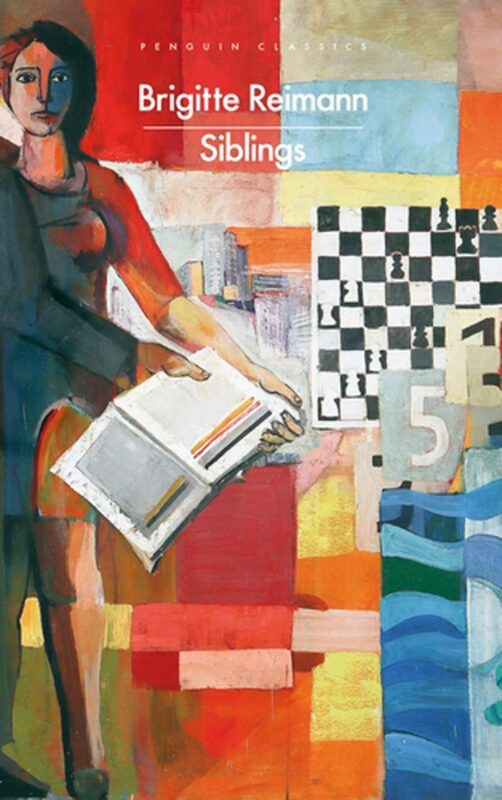
Siblings by Brigitte Reimann.
1960. The border between East and West Germany has closed.
For Elisabeth – a young painter – the GDR is her generation’s chance to build an egalitarian socialist future. For her brother Uli, it is a place of stricture and oppression. Separating them is the ever-wider chasm of the party line; over them loom the twin spectres of opportunity and fear, and the shadow of their defector brother Konrad. In prose as bold as a scarlet paint stroke, Brigitte Reimann battles with the clash of idealism and suppression, familial loyalty and desire. This fervid, ground-breaking novel, written when Reimann was only twenty-seven, remains one of the cult classics of East German literature.
Reviews: The Guardian / The New Yorker / The TLS
Interview on Open Book, BBC Radio 4 with Jenny Erpenbeck and Octavia Bright on 25 June 2023
Runner-up in the Schlegel-Tieck Prize 2023
Penguin Modern Classics & Transit Books · Fiction · 2023
Blueprint is a fictionalised account of a female student at the Weimar and Dessau Bauhaus schools in the 1920s. It demonstrates how, for all its progressiveness in artistic terms, Bauhaus was not as pioneering in its sexual politics. Fascinating insights into the school of architecture that made history and shaped art movements throughout the world. ‘Fast-paced, and highly topical, Blueprint depicts a young woman in the throes of life.’ Lois Innes writes in the preface: ‘The likes of Me Too and Stop Trump movements are encouraging demonstrations of feminist advocacy and suggest we are much quicker to articulate or call out misogyny than would have been the case 100 years ago. (…) Enzensberger (…) reminds us not to overlook certain institutions we deem safe or exempt from prejudice.’
Click here for an interview with the author in The Brooklyn Rail.
Dialogue Books · Fiction ·2019

I Have No Regrets, Diaries 1955-1963 by Brigitte Reimann
‚These diaries give a welcome introduction to Reimann’s work (…) There is passionate self-reflection, political insight and a fierce commitment to the art of fiction on practically every page’, wrote Ian Ellison in the Times Literary Supplement. These diaries ‘reveal and display her fundamental forthrightness (…) making for an unvarnished picture of life in the workers’ state that, in its focus on the essential-human, nevertheless doesn’t fit neatly the picture readers might expect. (…) One reason her work was underestimated in the Federal Republic during her lifetime (…) surely was because this was an unfamiliar, much more intimate-personal approach to political writing.’ They begin when she was 22 – the volumes before she burnt. The second volume, It All Tastes of Farewell Diaries 1964-1970, is translated by Steph Morris.
Seagull Books · Non-Fiction ·2019

Lyric Novella is a tale of a young aristocratic man’s obsession with a cabaret star set in the Weimar period in Berlin. Annemarie Schwarzenbach was a journalist, antifascist, archaeologist and traveller. In her youth, she spent some time in bohemian Berlin, where the photographer Marianna Breslauer took her portrait saying she was ‘the most beautiful creature I’ve ever met.’ In it, Schwarzenbach leans against a car, androgynous and distant. In psychologically acute prose, the protagonist of Lyric Novella is an incarnation of Schwarzenbach’s alter-ego, ‘leaving little doubt that Lyric Novella is a tale of lesbian love.’ (Naveen Kishore in New Books in German, autumn 2011).
Seagull Books · Fiction · 2011

Further publications with links to reviews
I Have No Regrets: Diaries 1955-1963, Brigitte Reimann, Seagull Books, London (2019), reviewed in the TLS, 9 October 2020 and the Complete Review
Death in Persia (2013), Annemarie Schwarzenbach, Seagull Books, reviewed in the TLS on 15 October 2021
Berlin Noir, Thomas Wörtche (ed.), Akashic Books, New York, reviewed in Kirkus Reviews, 7 May 2019
Living in the Anthropocene, Christian Schwägerl, Synergetic Press, Santa Fe (2014)